How to Choose the Right Dive Mask: The Complete Guide
From lens types to silicone skirts, prescription lenses to anti-fog: answers to every question asked when buying and using a dive mask.
- The one golden rule: the best mask is the one that fits your face best
- The lens must be tempered glass, the skirt must be silicone
- Most twin-lens models accept prescription lenses
- Fogging won't stop until the factory silicone film is cleaned off a new mask
- On try dives and courses all equipment, mask included, comes with the price
Why does the mask matter so much?
With water touching your eyes directly, you can't see clearly underwater; sharp vision needs an air pocket between eye and water. That is exactly the mask's job: building a dry room in front of your eyes. But what really separates a dive mask from swimming goggles is that it encloses your nose too: as pressure grows with depth you need to blow air into the mask through your nose, and you need to pinch your nose to equalise your ears. That's why nobody dives in swimming goggles; it's not a preference, it's physics.
Then there's comfort: the mask is the only piece of equipment sitting on your face for the whole dive. A leaking or fogging mask turns even the world's most beautiful reef into an ordeal. The good news: choosing the right mask isn't hard; you just need to know what to look for.
Anatomy of a mask
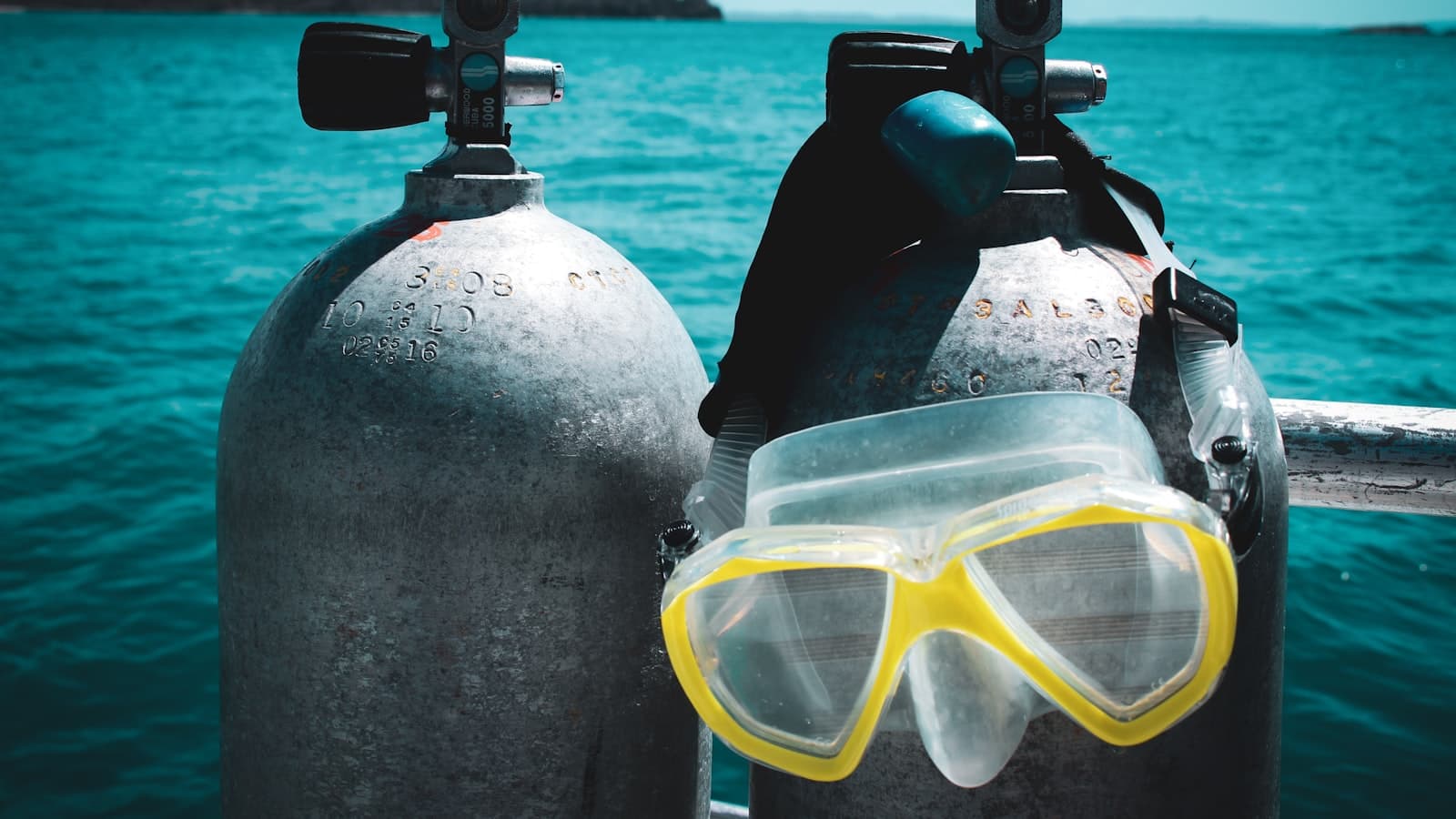
Lens: It must be tempered glass; it usually says "T" or "Tempered" on it. Tempered glass withstands pressure and, if it ever breaks, shatters into small granules instead of sharp shards. Toy masks with plastic lenses scratch and fog endlessly; they have no business in the sea.
Skirt: The soft part that sits on your face. On quality masks it's made of silicone; cheap ones use PVC. Silicone is soft, adapts to your facial contours and stays flexible for years; PVC hardens and leaks in no time. Most of the price difference between masks hides in this skirt.
Nose pocket: The soft compartment that lets you pinch your nose with two fingers to equalise. When trying a mask on, check that you can reach your nose easily, even with gloves.
Frame and strap: Framed models are sturdy and their lenses can be replaced; frameless models are lighter and sit closer to the face. The strap just needs to be wide, split and easy to adjust; what actually holds the mask to your face is water pressure, not the strap.
Single lens, twin lens or panoramic?
Single lens:One uninterrupted window above the nose. The view is airy, with no "frame down the middle" feeling. In exchange, the internal volume is usually a bit larger and prescription lenses can't be fitted.
Twin lens: Two separate lenses. The big advantage: on most models the lenses can be removed and swapped for prescription lenses. Internal volume is usually smaller, which also makes the mask easier to equalise and easier to clear of water.
Panoramic / multi-lens: Extra windows on the sides increase peripheral vision and the feeling of light. The price is higher internal volume and slight optical distortion at the side panes.
Low-volume masks: Freediving-derived models that hug the face closely. They equalise with little air and clear easily; they're perfectly good for scuba too, though the field of view is a bit narrower. The middle road for a first mask: a low-to-mid-volume twin lens: the most flexible, easiest-to-live-with choice.
The critical step: the face test
One rule comes before brand, price and reviews: the mask must fit your face. The most expensive mask leaks if it doesn't match your features; a modest mask that seals perfectly is wonderful. The test is simple and takes 30 seconds in a shop:
1) Place the mask on your face without the strap. Make sure no hair is caught under the skirt. 2) Inhale gently through your nose to create a slight vacuum inside. 3) Let go: the mask should stay on your face by itself, with no hissing of air while you hold the breath in. Let it sit a few seconds; meanwhile smile, pretend to talk; if your expressions lift the skirt, that mask isn't yours.
Repeat the test with a few models, and check that you can reach the nose pocket comfortably with two fingers and that the frame doesn't press on your forehead or cheekbones. Faces vary a lot; "my friend's mask" is not a reference.
Glasses and contact lens wearers
You can't wear glasses under a mask: the arms pass through the skirt and it leaks. But you're not without options; there are two good routes:
1) Contact lenses: Diving with soft lenses is common and practical. The only rules: squint during the mask-removal drill so a lens doesn't get washed away, and prefer daily disposables.
2) Prescription lenses: The removable lenses of many twin-lens models can be replaced with off-the-shelf corrective lenses. Ready-made lenses usually come in 0.5 steps, roughly -1.0 to -8.0 for short-sightedness; long-sighted and bifocal options exist too. For strong astigmatism, custom lenses from an optician are also possible: pricier, but the sharpest solution. Note: water already magnifies objects by about a third; low prescriptions (around ±1) rarely cause problems underwater.
If you're heading to a try dive and your prescription is strong, tell us upfront; we'll confirm in advance whether the partner dive centre has prescription masks; many centres stock the common strengths.
Fogging: why it happens, how it ends
Fog is moisture from your breath and the mask interior condensing on cold glass; it becomes persistent when it finds something microscopic to cling to. Two separate problems need telling apart:
New-mask syndrome: Every lens leaves the factory with an invisible film of silicone, and that film attracts fog like a magnet. Spray can't dissolve it. The cure is to scrub the inside of the lens with plain white non-gel toothpaste and a finger before first use, rinse thoroughly, and repeat if needed. (Some divers burn the film off with a lighter flame; it works, but we don't recommend it because of the risk to the silicone skirt and coated lenses; the manufacturer's cleaning instructions always come first.)
Everyday fog: Even a clean lens needs a pre-dive routine. Commercial anti-fog gels and sprays do the job well; the traditional method on every boat in the world is to spit on the inside of the glass, spread it and rinse in the sea: not elegant, but effective. Whichever you use, apply it while the mask is dry and rinse once, right before the dive.
Beards, moustaches, hair and kids
Moustache: If there's hair along the line where the skirt sits under your nose, some leaking is normal. The fix is either trimming that thin strip, or applying a small amount of silicone-based gel or balm to the moustache before diving. Petroleum products like Vaseline degrade the silicone skirt over time; don't use them.
Beard: Dense beard in the skirt area on the cheeks causes similar minor leaking. Most bearded divers learn to live with it: clearing the mask now and then takes seconds.
Hair: The most common beginner mistake is a few strands of hair caught under the skirt; even a single strand opens a channel and lets water in. Sweep your hair back off your forehead before putting the mask on. For long hair, fabric strap covers that stop the silicone strap tangling are a tiny expense and a lifesaver.
Kids: An adult mask doesn't fit a scaled-down face; there are proper children's models with narrow skirts and small volume. Same rule: a real mask with tempered glass, not a plastic-lens beach toy.
The snorkel-mask trap: no diving with full-face masks
The full-face snorkel masks that have spread across beaches in recent years cannot be used for scuba diving. The reason is simple: you can't reach your nose to equalise, you can't fit a regulator, and they aren't designed for depth pressure. They are for surface snorkelling only; even there, calm water is recommended. In dive training and on the boat you will always be given a classic mask plus a separate snorkel. (The real full-face scuba masks used in professional diving are a separate topic requiring special training.)
What are you paying for?
Since figures change with model and exchange rate, it's more useful to look at what pushes the price upthan at a price band: a quality, hypoallergenic silicone skirt, tempered lenses with a system that accepts prescription glass, a low-volume design, and a solid buckle/strap mechanism. Even entry-level masks from recognised dive brands meet these basic criteria; the most expensive model is not "the best mask"; the one that fits your face best is.
Where to buy? A real dive shop is the right address for a first mask, because it lets you try before buying. If you're buying online, test the same model on your face in a shop first.
Care, storage, lifespan
Mask care is a two-minute habit: rinse with fresh water after every dive (salt crystals wear the silicone out), dry in the shade and store in the hard box. Sun is silicone's number-one enemy: a mask left behind a windscreen sees its clear skirt yellow, then harden. Keep it away from harsh detergents and solvents; check the strap now and then. That's it. In return, a quality mask keeps you company for a comfortable 5–10 years.
Do you need your own mask for a first dive?
No. On a try dive and on courses, all equipment including the mask is provided by the dive centre and included in the price; you don't need to buy anything for day one. If you'd like to bring your own mask, nobody will object; many people prefer it for hygiene and familiarity.
If you've fallen for diving and you're buying your first personal equipment, the order is almost universal: mask first (the one truly face-specific piece), then snorkel and fins. Renting the rest for a long while is both normal and sensible; we cover it all in the gear guide.